Summarize this page via
Perplexity vs Claude: Which AI is better for blog writing?
 Jan 25, 2026
 16 minutes
Are you looking for a tool that can help you create publish-ready blogs without the extra hassle? Keep reading on to find out the best AI solution for blog writing.
Perplexity and Claude represent two distinct workflows for AI assistance. One prioritizes research and sourced information, while the other focuses on thoughtful and nuanced writing.
If you are a writer or blogger trying to choose between them, you should understand the Perplexity vs Claude differences in detail to determine which tool actually helps you create better blog content.
This comparison examines Perplexity vs Claude specifically for content writing and blogging tasks. We’ll look at how each handles research, writing quality, content depth, and the practical realities of using them for regular content production.
General overview of Claude’s capabilities
Claude is Anthropic’s AI assistant. It is designed with a focus on being helpful, harmless, and honest. Content writers can use Claude’s features that center on content creation to handle nuanced, complex tasks.
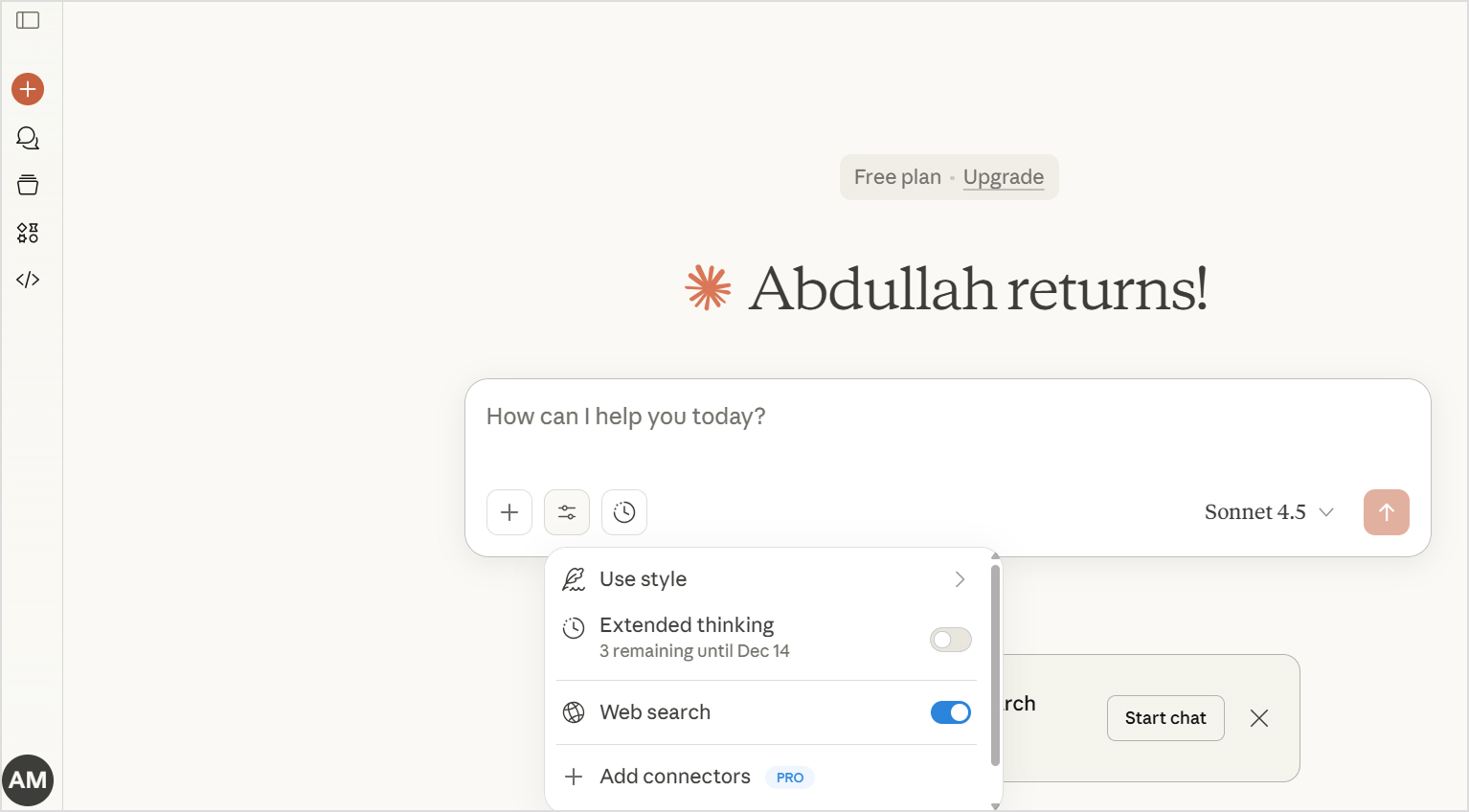
The platform offers multiple model tiers. Claude 4.5 Sonnet handles most tasks efficiently, while Claude 4.5 Opus provides more sophisticated reasoning for complex work.
Key capabilities relevant to bloggers:
- Extended context window. Claude can process up to 200,000 tokens in a single conversation, allowing it to work with lengthy documents, maintain context across long writing sessions, and reference substantial source material while writing.
- Writing style range. Claude adapts to different tones and formats, from technical documentation to conversational blog posts. It can match provided examples and adjust formality levels based on guidance.
- Nuanced instruction following. Claude handles complex, multi-part prompts reasonably well. You can provide detailed briefs with specific requirements, and you can generally expect the output to address most of your criteria.
- Artifacts for longer content. The artifacts feature lets Claude create standalone documents, code, and other outputs that you can iterate on separately from the main conversation.
Claude performs well for blogging at different stages, including drafting, expanding outlines, rewriting for clarity, and adapting content for different audiences. The writing tends toward thorough and considered rather than punchy and brief.
Also read: Claude vs ChatGPT
General overview of Perplexity’s capabilities
Perplexity AI positions itself as a research-first tool. Unlike traditional chatbots that generate responses from training data alone, Perplexity searches the web and synthesizes information from multiple sources.
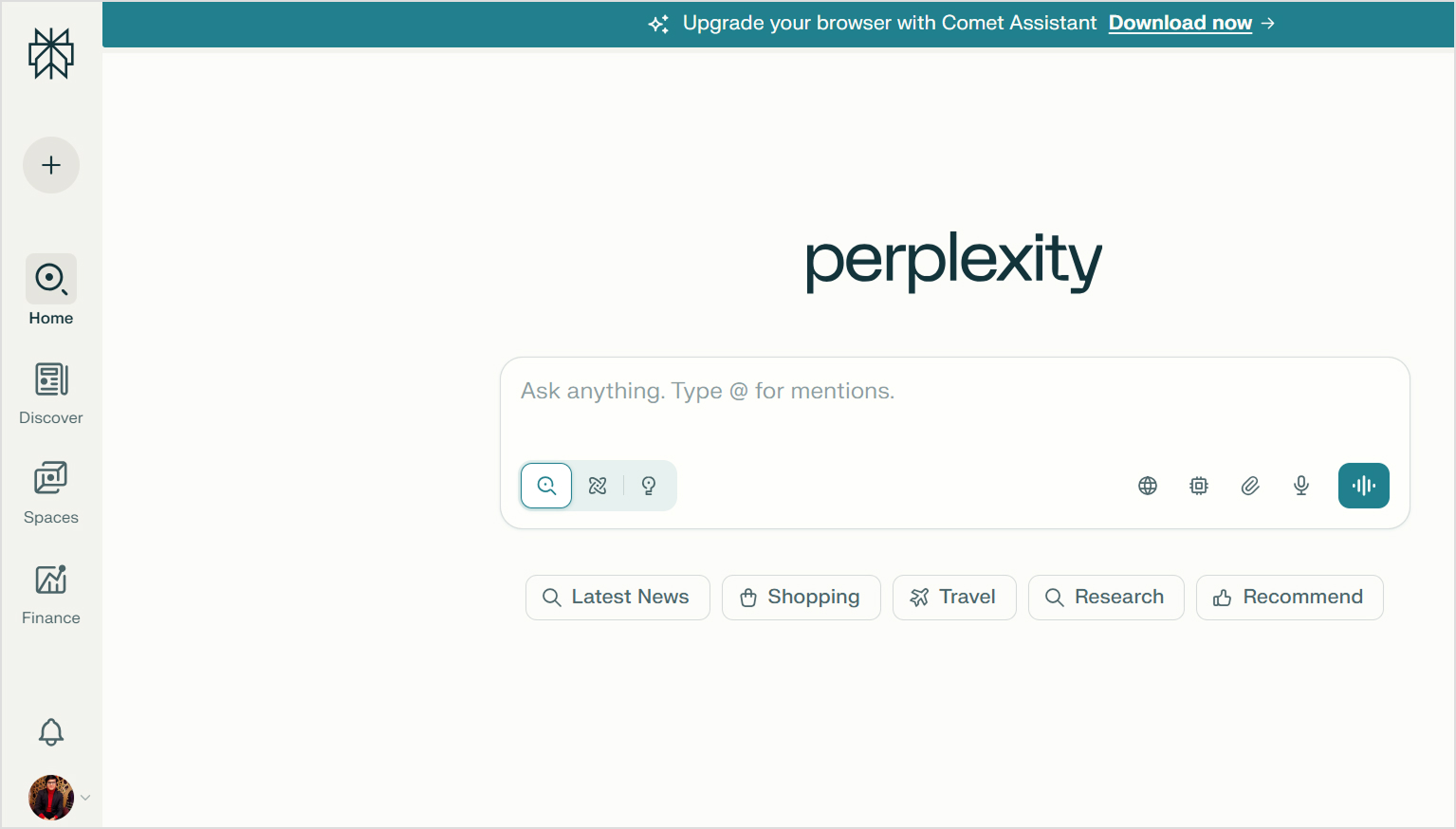
This research-centric approach has specific implications for content creators. When you ask Perplexity about a topic, it doesn’t just give you an answer; it shows you where that answer came from. Every response includes numbered citations linking to source material.
Core features for bloggers:
- Automatic source citation. Each claim connects to its origin, making fact-checking straightforward and helping you build credibility when you need to reference information in your content.
- Focus modes. Perplexity lets you limit searches to specific source types: academic papers, Reddit discussions, YouTube videos, or general web results. This targeting helps when you need specific types of research.
- Pro Search. The premium feature conducts more thorough research, asks clarifying questions, and provides deeper analysis for complex queries.
- Collections. You can organize research by topic, building reference libraries for ongoing content projects.
- Multi-model access. Perplexity Pro subscribers can choose from different AI models (including Claude and GPT-4) to generate responses, offering flexibility in how information is synthesized.
The tradeoff is clear: Perplexity prioritizes verifiable accuracy over polished writing. If you need to fact-check AI-generated content, Perplexity’s citation-forward approach makes that easier than with most other AI tools.
Also read: Perplexity vs ChatGPT
Comparing Perplexity vs Claude
Here’s how Perplexity vs Claude compare across key factors for blog content creation:
| Feature | Perplexity AI | Claude |
| Primary strength | Research with citations | Writing quality and nuance |
| Citation quality | Excellent. Every claim is cited | None. No built-in source linking |
| Real-time information | Yes, searches live web | Yes, can retrieve real-time information from the web |
| Writing style | Concise and factual | Adaptable and thorough |
| Best for | Research, fact-gathering, verification | Drafting, editing, and complex writing tasks |
| Free tier | Generous with core features | Limited daily messages |
| Premium cost | $20/month (Pro) | $17/month (Pro) |
| Context window | Moderate | Very large (200K tokens) |
| SEO features | None built-in | None built-in |
| Long-form content | Limited. Outputs are brief | Strong. Maintains coherence |
| Instruction following | Basic | Detailed and nuanced |
| Image generation | Available in Pro | Not available |
Perplexity vs Claude for research
Perplexity was built for research. Every query triggers a web search and provides inline citations you can verify. Focus mode lets you target academic papers, Reddit discussions, or general web results.
So, bloggers who gather facts, statistics, and current information can find this automated research with built-in verification vital for saving time.
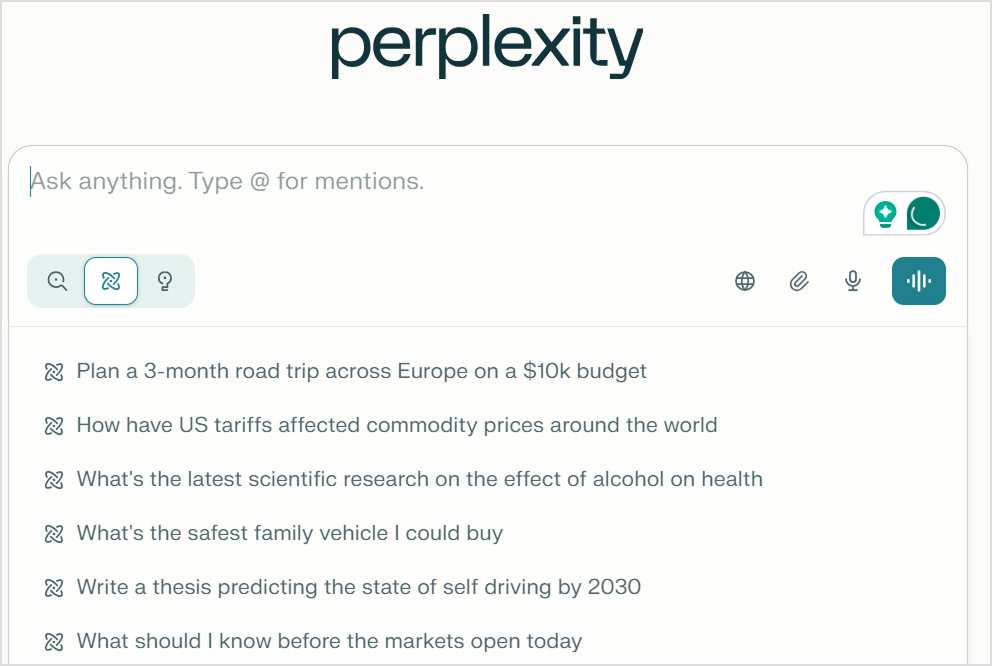
Claude works primarily from training data with a knowledge cutoff, meaning it can’t access current information unless you enable the web search option. What Claude does well is synthesize the information you provide, analyzing multiple sources and extracting insights.
Verdict
Perplexity wins for research as automatic web search with source citations beats relying on potentially outdated training data.
Also read: Claude vs Gemini
Perplexity vs Claude for reasoning
Perplexity reasons well within its research framework, processing information across sources and identifying patterns. Pro Search considers multiple angles and provides nuanced responses.
However, Perplexity stays close to its sources and rarely makes creative leaps or generates insights beyond what it finds online. This is intentional because of its accuracy-first approach.
Claude shows stronger general reasoning abilities, particularly for abstract thinking, argument construction, and analysis that doesn’t require source backing. It explores implications, anticipates counterarguments, and works through complex topics systematically.
Verdict
Claude wins for reasoning. Stronger analytical depth and creative thinking outweigh Perplexity’s source-anchored but more limited reasoning.
Perplexity vs Claude for writing
Perplexity generates text as an extension of its answer function. The output is competent but concise, prioritizing clarity and accuracy over style. Responses are well-organized but not distinctive or engaging.
Claude was designed for sustained writing tasks. The output reads naturally, adapts to different styles, and maintains coherence across longer pieces. It handles shifts between formal and casual, technical and accessible, and can approximate specific brand voices with proper examples.
Verdict
Claude wins for writing. It provides more natural content, a better style range, and stronger long-form capability for actual content creation.
Also read: How to use AI for content creation
Perplexity vs Claude for content depth
Perplexity achieves depth through the breadth of sources. It pulls information from multiple sites, surfacing details and perspectives you wouldn’t find in a single search. The citation system lets you follow any thread deeper by checking original sources.
Claude handles depth through reasoning and elaboration. Give it a topic, and it explores implications, considers edge cases, and builds comprehensive arguments from its knowledge.
Verdict
It depends. Perplexity offers source-verified breadth, while Claude offers reasoning-driven analytical depth. Choose based on whether you need aggregated facts or developed analysis.
Perplexity vs Claude for image generation
Perplexity includes image generation through DALL-E integration. You can create images directly within your research workflow, which streamlines content creation when you need both information and visuals. On the other hand, Claude doesn’t generate images.

Verdict
Perplexity wins by default. Claude simply doesn’t offer image generation, leaving Perplexity as the only option between the two if you need visuals.
Perplexity vs Claude in SEO understanding
Perplexity has no built-in SEO features but researches SEO topics effectively. Ask about current best practices, search intent, or what’s ranking for target keywords, and it finds relevant, cited information.
Claude also doesn’t have any built-in SEO features, but it understands SEO concepts well and can discuss optimization principles knowledgeably. It analyzes content you paste in, suggesting improvements for headings, structure, and keyword variations.
Verdict
We’ll give a slight edge here to Claude. It provides better SEO assistance and more natural keyword incorporation, though neither of the tools replaces dedicated SEO writing tools.
Creating a real blog with Perplexity and Claude
To see how these tools perform in practice, we gave both the same prompt:
“Write a short and SEO-optimized blog post about Human vs AI-Powered Blog Writing.”
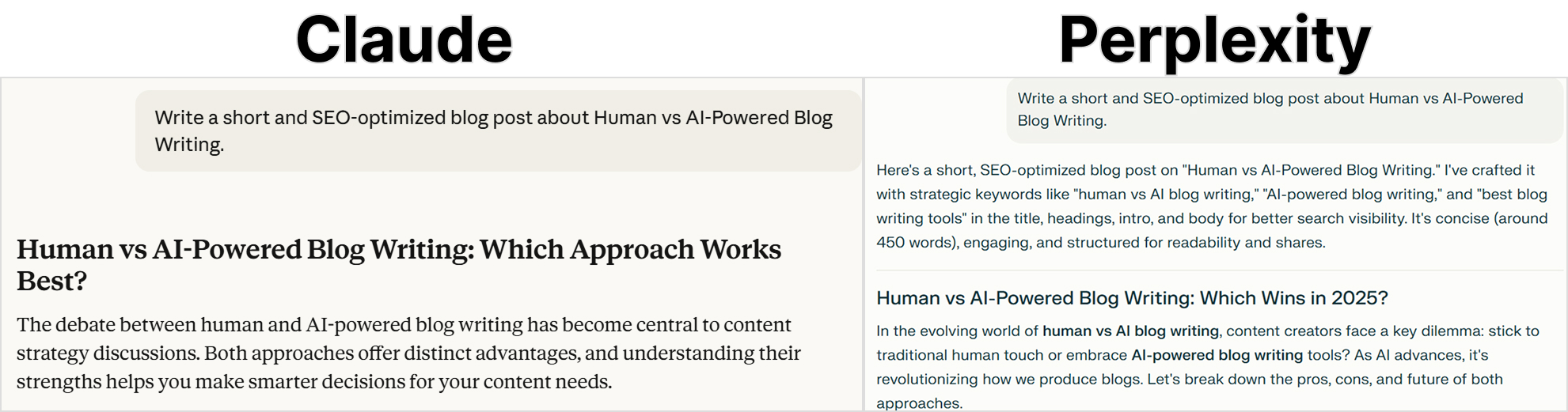
The results reveal apparent differences in how each tool approaches content creation.
Claude’s output
Claude produced a structured article with clear sections, totaling 328 words. The content takes a balanced, analytical approach. Claude explores the nuances of when each approach works best and concludes that the hybrid model is the practical solution. The content reads like something a human editor would produce with minimal revision needed.
Perplexity’s output
Perplexity delivered a more explicitly SEO-optimized piece with bullet points, a numbered structure, and direct keyword inclusion, totaling 340 words.
The approach is more promotional in tone, ending with a direct call-to-action: “Ready to try? Test free AI tools and compare your results!”
Perplexity also personalized the content, and the overall writing leans heavily on lists and short paragraphs, making it scannable but less cohesive as prose. It reads more like a marketing blog than an editorial piece.
What this comparison reveals
The outputs reflect each tool’s core philosophy.
Claude prioritized writing quality, producing prose that flows naturally and makes a coherent argument. Perplexity prioritized SEO signals, producing content structured for search visibility with explicit keywords, bullet points, and actionable formatting.
Neither output was perfect. Claude could have included more concrete examples and data points. Perplexity’s aggressive keyword insertion (“human vs AI blog writing” appears four times in 340 words) appears as over-optimization. Both would benefit from human editing before publication.
Claude’s strengths
Based on the real test and regular usage, here’s where Claude consistently delivers:
- Natural prose quality. Claude’s output reads like polished editorial writing. Sentences flow into each other, paragraphs build logically, and the overall piece feels cohesive. You’re getting quality content that needs minimal structural editing.
- Balanced, nuanced analysis. Rather than taking a simplistic stance, Claude explored the complexity of human vs AI writing and arrived at a reasoned conclusion. For content that requires weighing multiple perspectives, this analytical depth adds value.
- Appropriate restraint. Claude didn’t over-optimize with keyword stuffing or aggressive formatting. The term “human vs AI” appeared naturally rather than being forced into every paragraph.
- Professional tone without being sterile. The writing is authoritative but accessible. It sounds like a knowledgeable person explaining something rather than a textbook or a marketing pitch.
- Complete argumentation. Claude built toward a conclusion (the hybrid approach) and supported it with reasoning throughout. Readers finish with a clear takeaway and understand why that conclusion makes sense.
Claude’s weaknesses
The test also revealed genuine limitations:
- Light on specific data. Claude’s output included no statistics, percentages, or concrete numbers. Claims like “AI handles the heavy lifting” lack the supporting evidence that builds credibility. For data-driven content, you’d need to add specifics yourself.
- Conservative formatting. While the restraint on bullet points produced better prose, some readers prefer scannable content. Claude’s wall-of-text approach may not perform as well for audiences who skim rather than read.
- Generic examples. The piece discussed human and AI writing in abstract terms without naming specific tools, real companies, or concrete scenarios.
- Missed explicit SEO signals. Claude doesn’t automatically provide keyword density, meta description suggestions, or structured SEO data.
Also read: 12 best AI SEO tools
Perplexity’s strengths
Perplexity showed clear advantages in several areas:
- Explicit SEO optimization. Perplexity interpreted “SEO-optimized” literally, including the target keyword phrase multiple times, using scannable bullet points, and structuring content for search visibility.
- Specific data and claims. The output included concrete numbers (“30-50% time savings,” “5x productivity boost”) and named actual tools (Grok, Jasper, ChatGPT, SEMrush) for readers.
- Scannable formatting. Bullet points, short paragraphs, and clear section breaks make Perplexity’s content easy to skim. For audiences who scan before reading, this structure improves engagement.
- Action-oriented conclusion. The piece ended with a clear call to action, encouraging readers to test AI tools. For content designed to drive specific behaviors, this direct approach is more effective than Claude’s conclusion.
Perplexity’s weaknesses
The test revealed significant limitations for blog writing:
- Choppy prose flow. Individual points are clear, but the piece lacks the cohesive narrative that keeps readers engaged through longer content.
- Promotional tone. Phrases like “Lightning-Fast Output” sound like marketing copy rather than editorial content. For blogs aiming to inform rather than sell, this tone may feel off-putting to readers.
- Less analytical depth. Perplexity presented information in parallel lists without deeply analyzing the tradeoffs or building a sophisticated argument. The hybrid recommendation appears, but it isn’t as developed as Claude’s.
- Inconsistent quality within sections. Some bullet points are insightful while others feel like filler. The quality varies more than Claude’s consistently polished output, requiring more editing to achieve uniform quality.
User reviews for Perplexity and Claude
Real user feedback reveals what marketing pages won’t tell you. Here’s what actual users say about both tools on G2, a software review platform.
Claude user reviews
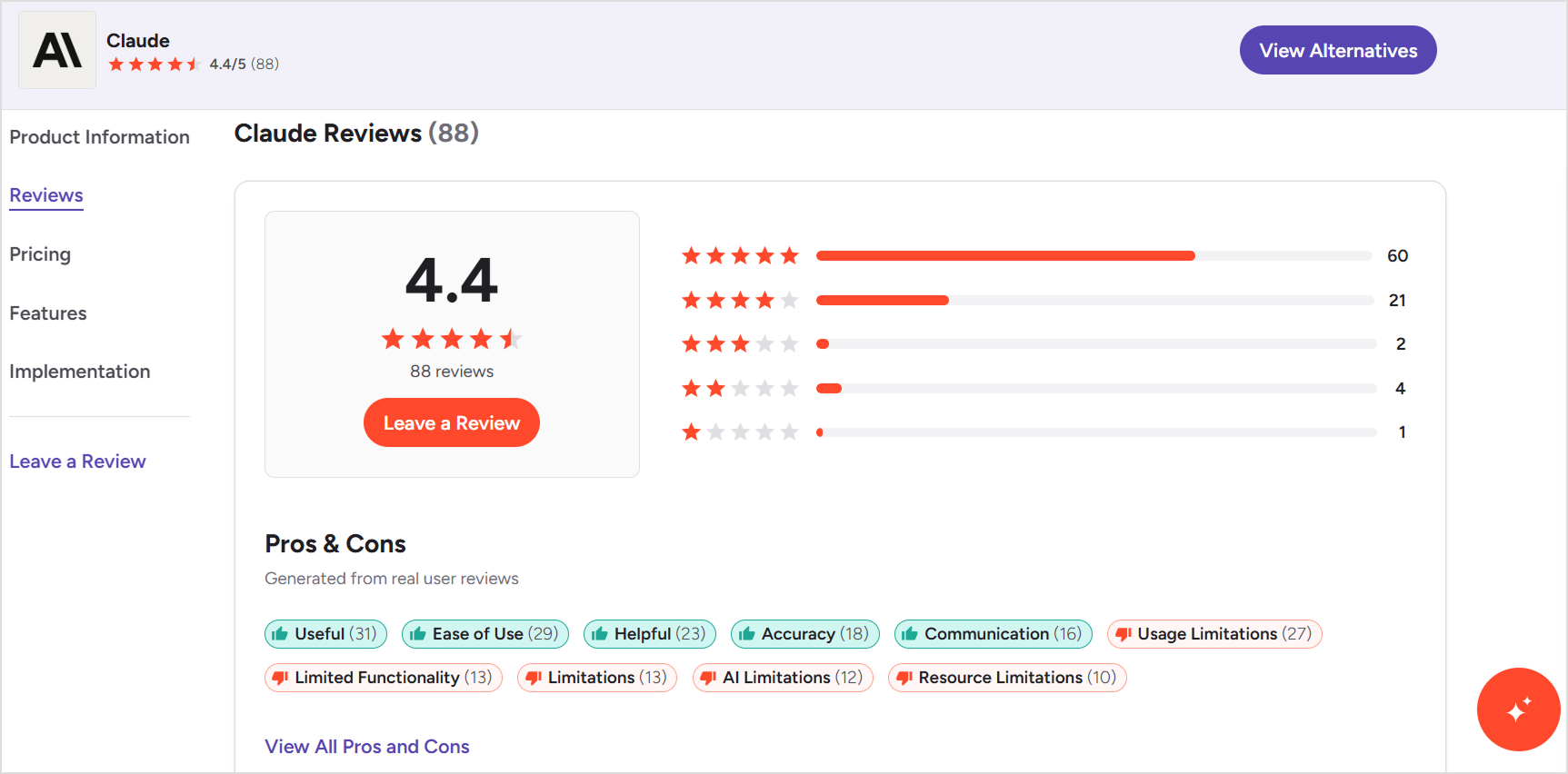
Users consistently praise Claude for depth and nuanced thinking. One writer noted that Claude “organized a discussion with counterarguments to develop the subject” for their novel, highlighting its strength in complex, analytical conversations.
Technical users appreciate the model architecture. One reviewer highlighted the practical distinction between Opus 4 for “long-running, multi-step reasoning, codebase-scale refactors, and research-style synthesis” and Sonnet 4 for “daily coding, support, and agent sub-tasks”.
The criticisms center on cost and complexity. Technical users note that “Opus 4’s higher output costs and extended thinking can increase spend and latency on verbose sessions,” requiring careful token management.
Also read: Perplexity vs Gemini: An honest comparison for content writers
Perplexity user reviews
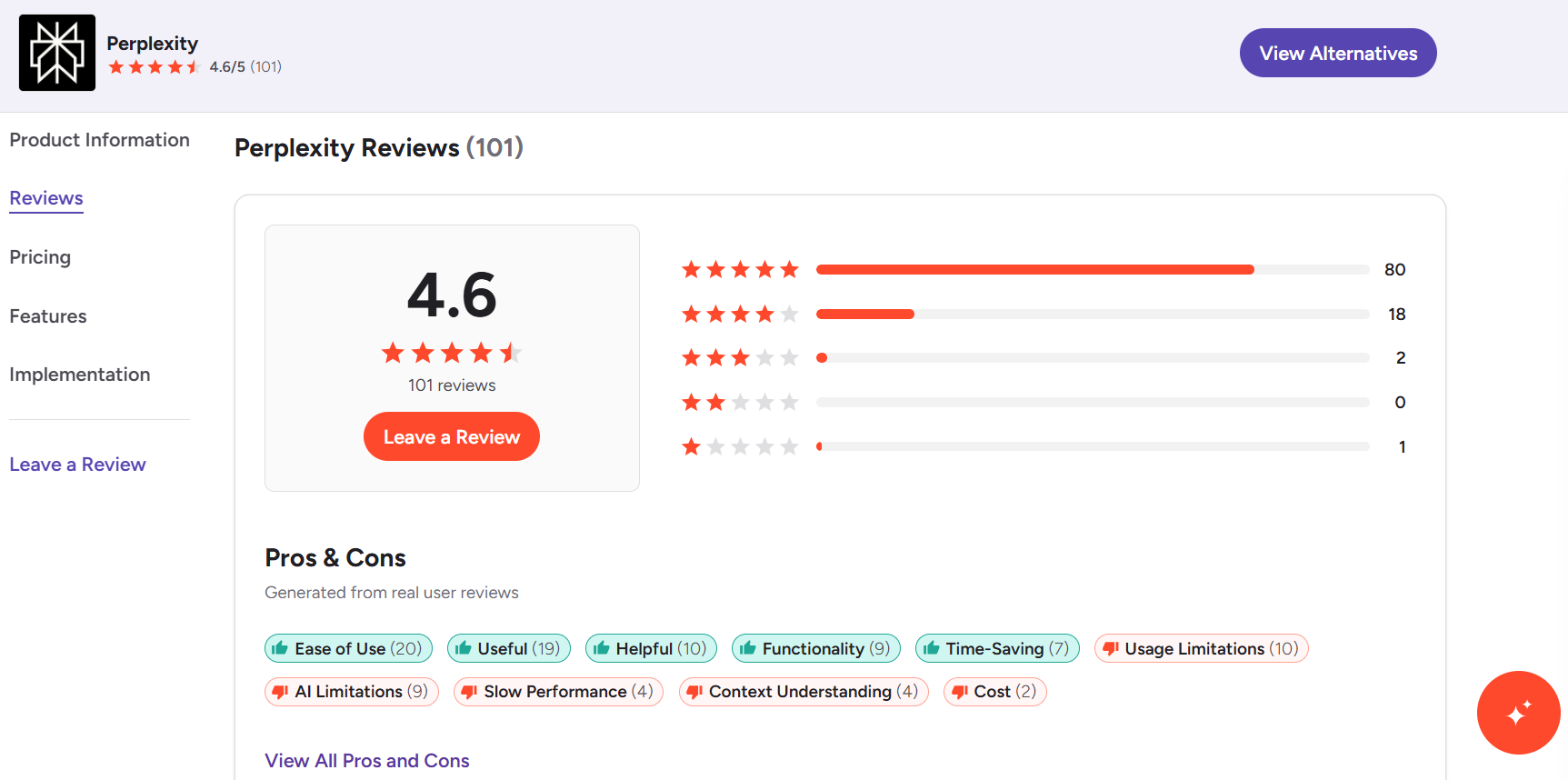
Perplexity users emphasize speed and research efficiency. One reviewer praised its ability to combine “the power of an AI language model with real-time web search” for “up-to-date, sourced answers almost instantly.” The transparent source citations and clean interface came up repeatedly as standout features.
For workplace use, Perplexity shines in specific scenarios. A marketing professional uses it “daily at work for quick research, getting summaries, and checking facts when preparing marketing or partner reports.”
The limitations users identify align with our testing. Multiple reviewers note that “depth of answers can feel a bit limited compared to GPT-4” and that it’s “less helpful for creative writing or brainstorming.”
Summary of user reviews of Perplexity vs Claude
The rating difference is marginal, but the feedback patterns differ meaningfully. Claude users value depth, reasoning, and the ability to handle complex tasks. Perplexity users value speed, sources, and research efficiency.
For blogging specifically, the reviews suggest Claude fits better when you need analytical depth and polished writing. Perplexity fits better when you need fast, verified research.
Contentpen: A better alternative to Perplexity and Claude for blog writing
Both Perplexity and Claude offer valuable capabilities, but neither is designed specifically for blog content creation. Perplexity excels at research. Claude excels at writing.
But bloggers need a tool to handle the complete content workflow: researching, writing, optimization, and publishing in one focused solution.
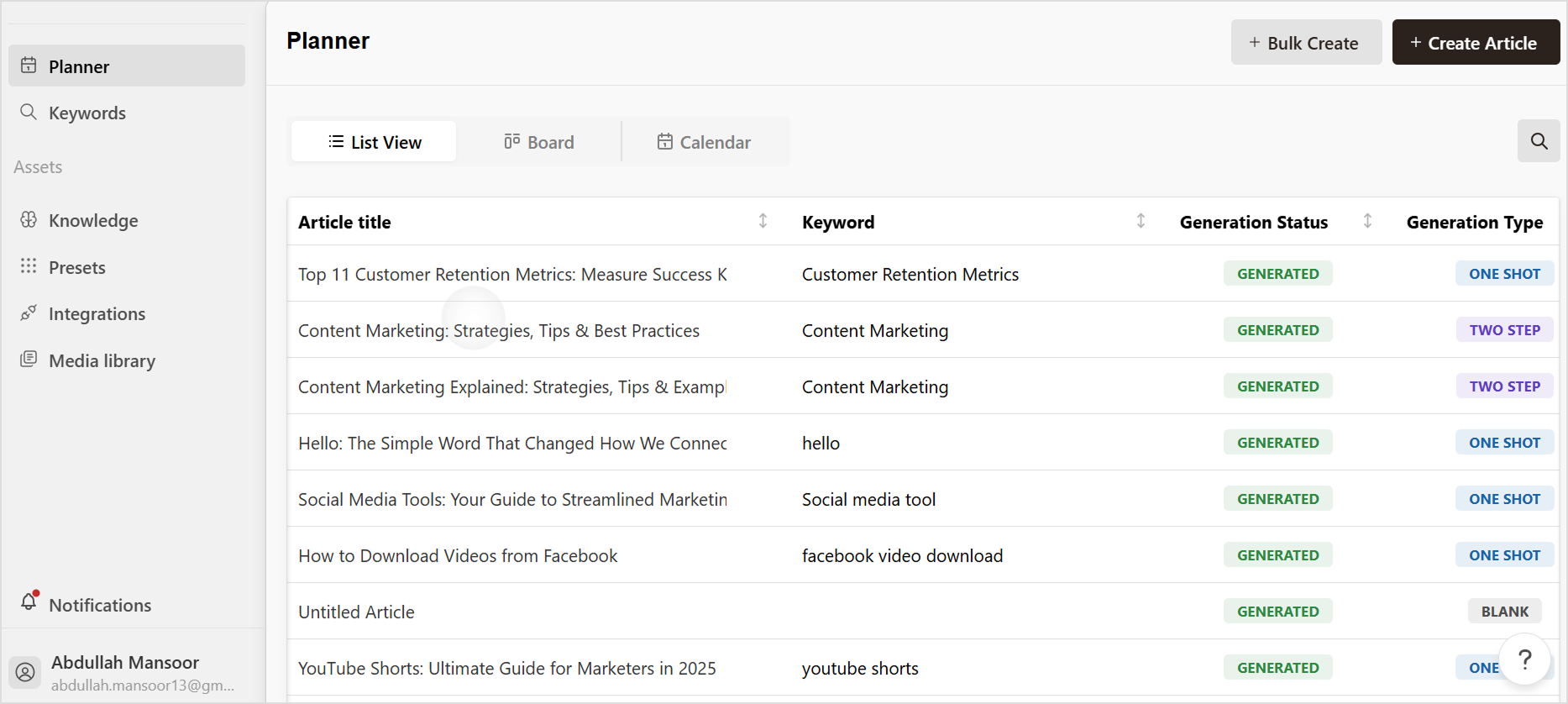
Contentpen addresses this gap. Rather than adapting general-purpose AI to blogging, it’s built around what content creators actually need.
- Research and writing together. Contentpen handles keyword research natively, helping identify high-opportunity keywords to improve SERP rankings. The writing process incorporates this research, so the content is optimized from the start.
- SEO is built into the workflow. Where Perplexity and Claude require separate SEO tools, Contentpen includes SEO scoring that evaluates content as you create it. You see optimization opportunities in real time, along with article meta titles and descriptions.
- Complete blog creation. Contentpen generates full, publish-ready blog posts through its blog creation feature. Also, the writing style adapts to your required brand voice, and the flow is much more natural and human-like than other AI tools on the market.
- Direct publishing integration. Through integrations and publishing features, Contentpen connects directly to WordPress, Ghost, Wix, and other CMS platforms. This eliminates the copy-paste workflow that general AI tools require.
- Scale when you need it. For content teams or bloggers managing multiple sites, bulk content creation lets you produce multiple optimized posts efficiently.
The comparison isn’t entirely fair. Perplexity and Claude serve broader purposes beyond blogging, and they’re valuable for many tasks.
But, for bloggers and content creators specifically seeking tools to improve their content workflow, a purpose-built solution like Contentpen outperforms adapted general-purpose AI.
Also read: Use AI to write blog posts
Final verdict: Which AI is better for blog writing?
After comparing both tools across research, reasoning, writing quality, content depth, and SEO understanding, here’s the straightforward assessment of Perplexity vs Claude:
Choose Perplexity if:
- You write fact-heavy content requiring citations
- You need current information and real-time web access
- You’ll handle the polished writing yourself or with another tool
- You want image generation capabilities
Choose Claude if:
- Writing quality and style matter most
- You produce long-form content requiring sustained coherence
- You need help with analysis, arguments, and nuanced thinking
In practice, most bloggers find that these tools serve different functions. You might find that our AI blog writer serves you better than juggling multiple AI assistants. However, you are free to test each tool and let the results guide your choice.
Frequently asked questions
Not entirely. Perplexity and Anthropic serve different purposes. Perplexity is a research tool with web search and citations, while Anthropic’s Claude AI excels at writing and reasoning.
It depends on the task. Perplexity beats Claude for research with real-time web access. GPT-5 offers similar writing quality with more integrations. For specific blogging needs, purpose-built tools like Contentpen outperform general AI assistants.
For research with citations, Perplexity remains top-tier. For writing quality, Claude and GPT-5 produce better prose. For complete blog creation with SEO optimization, dedicated platforms like our AI blog writing tool offer more comprehensive solutions than any general-purpose AI.
No. Claude is developed by Anthropic, while Perplexity is a separate company that offers access to multiple AI models within its platform.
The major AI players are OpenAI (ChatGPT), Google (Gemini), Anthropic (Claude), and Meta (Llama). Microsoft is often included due to its OpenAI partnership and Copilot products. Perplexity, while smaller, has carved out a significant niche in AI-powered research.
Perplexity AI is an independent company founded in 2022 by Aravind Srinivas (CEO), Denis Yarats, Johnny Ho, and Andy Konwinski. It’s backed by investors, including Jeff Bezos and Nvidia, but operates independently from major tech companies.
Both offer free tiers with limitations. Claude’s free version has daily message caps. Perplexity’s free tier limits Pro Searches but offers unlimited basic queries. Both charge a premium to provide users with higher limits and advanced features.
Subscribe to our newsletter

Join our subscriber list to get the latest blogs, product updates, and industry news!
By subscribing you agree to our terms of service and privacy policy.
You might be interested in...
Perplexity vs Gemini: An honest comparison for content writers
Looking for the best AI assistant for blog writing? Struggling to simplify your workflow and meet publishing deadlines? Worry not, we’ve got you covered with the solution! With so many options promising to transform your content workflow, two tools always stand out: Perplexity AI and Google’s Gemini. These platforms have varying working processes for using […]
Jan 23, 2026
Copilot vs Gemini for content creators: The ultimate 2026 showdown
The AI assistant marketplace is becoming competitive, with Microsoft Copilot and Google Gemini emerging as two prominent contenders for content creators. Both platforms promise to help you use AI to write blog posts efficiently, enhance productivity, and deliver quality content, but they take different approaches to achieve these goals. If you’re a blogger, content marketer, […]
Jan 16, 2026
Claude vs Gemini: The ultimate showdown for content creators in 2026
If you’re a content creator, blogger, or digital marketer trying to decide between Claude and Gemini, you’re not alone. Both AI assistants have carved out impressive niches in the content creation space, but which one actually delivers better results? In this comprehensive comparison, we’ll put Claude and Gemini head-to-head across multiple aspects that matter most […]
Jan 14, 2026